

Elon Musk Says Money Will Become “Irrelevant”
- Probal DasGupta
- Apr 20
- 5 min read
Entrepreneur. Storyteller. Systems Thinker. | Architect of Enterprises That Think | Founder & CEO.
December 12, 2025

Economists, Scholars, and AI Researchers Strongly Disagree. Here’s Why - On November 19, 2025, at the US–Saudi Investment Forum, Elon Musk made a prediction so bold it instantly lit up the global tech conversation: “Money will stop being relevant.”
It’s a compelling vision: AI produces everything, robots eliminate scarcity, and life becomes an endless stream of abundance. No prices. No banks. No wages. No financial stress. But if you look at what economics, complexity science, and human-action theory actually tell us, one conclusion becomes unavoidable:
Money can evolve, but it cannot become irrelevant.
The logic is deeper, older, and far more grounded in scholarship than Musk’s claim suggests. Let’s break this down. Money Doesn’t Exist Because Trade Is Inconvenient.

Money Doesn’t Exist Because Trade Is Inconvenient.
It Exists Because the Future Is Uncertain. We’re often taught that money exists to make trade easier than barter. True, but superficial. Economists from Adam Smith to modern researchers at the Bank for International Settlements point to a more fundamental truth: Money is humanity’s tool for navigating uncertainty.
Ludwig von Mises, in his landmark work Human Action (Mises Institute), argued that people hold money because the future is unknowable. Not “hard to calculate.” Not “poorly modelled.” Unknowable. Money is the most liquid, flexible way to prepare for whatever tomorrow throws at us, opportunity or disaster.
When Musk says money will disappear, he is implicitly saying: uncertainty will disappear. But this runs directly against more than a century of economic scholarship.
Economic Theory: Uncertainty Is Not a Bug, It’s a Feature

Leading economists, including Frank Knight, Friedrich Hayek, and contemporary scholars like Daron Acemoglu, have shown that markets exist because individuals face different knowledge, beliefs, and expectations about the future. This is not just anecdotal. It’s formalized in:
Knightian uncertainty (unknown unknowns)
Hayek’s knowledge problem (no central system can aggregate all knowledge)
Austrian praxeology (action is inherently future-oriented)
Modern complexity economics (systems generate unpredictable emergent outcomes)
In fact, economic models that assume perfect foresight collapse into triviality, nothing happens, no one trades, and money is unnecessary only because no one ever changes their mind. Real humans don’t work like that. And neither does the empirical economy.
AI Cannot Eliminate Uncertainty; Scholarship Is Clear on This
Musk’s prediction rests on a key assumption: AI will become so powerful it can anticipate all future needs. But the most serious academic work on AI and the economy contradicts this.
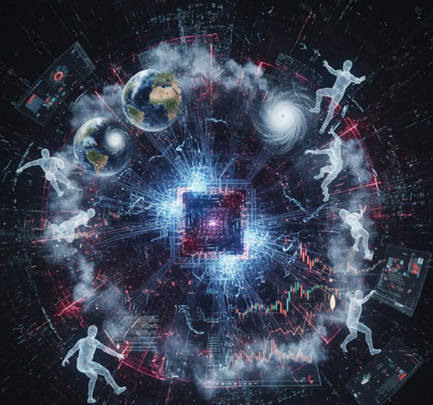
AI cannot predict complex natural phenomena: Research in complexity science and computational modelling (MIT, Santa Fe Institute) shows that natural systems, climate, biology, and geophysics contain irreducible unpredictability. No amount of computing power turns chaos into certainty.
AI cannot fully predict human behaviour: This is not just a philosophical claim; it’s backed by action theory (Mises) and formal argumentation (Hoppe):
• Humans learn.
• Learning changes preferences.
• Preferences shape choices.
• Choices cannot be perfectly forecasted because future knowledge cannot be known today.
MIT economists studying labour and AI (Acemoglu, Autor) have also shown that AI transforms tasks and incentives but does not reduce the variance of human decision-making; in many cases it increases it.
AI actually introduces new forms of uncertainty: Research summarized in Economic Impacts of Artificial Intelligence (NBER) concludes:
• AI accelerates innovation cycles
• which increases market volatility
• which increases the need for hedging tools; i.e., money and financial markets AI doesn’t remove uncertainty. It amplifies it.
Post-Scarcity Research Still Doesn’t Predict the End of Money
Economists and futurists have explored post-scarcity models, everything from the “Infinity Economy” (ResearchGate, 2023) to the cultural economics of Trekonomics. But these models repeatedly acknowledge:
Human desires do not become finite.
Coordination mechanisms remain necessary.
Value signals (prices) cannot vanish unless choice itself disappears.
In short: even in theoretical abundance, scarcity shifts but never disappears. Scarcity of: Attention
Prestige
Status
Time
Prime location
Authentic human experiences
These cannot be mass-produced by robots. And people will want them precisely because they are scarce.
The Economic Calculation Problem Still Applies in an AI World

Mises and Hayek famously argued that without prices, rational allocation is impossible. This isn’t outdated theory; it’s been validated in modern AI coordination studies. Price systems encode:
human preference signals
risk assessments
opportunity costs
distributed subjective valuations
AI can use these signals, but it cannot replace them. Even cutting-edge reinforcement learning systems rely heavily on external reward signals. In economic settings, these signals are prices. Eliminate money, and you eliminate the information structure that allows any advanced system; human or AI - to coordinate production rationally.
Abundance Isn’t Certainty. And Certainty Isn’t Possible.
Robots might one day build homes, harvest crops, assemble devices, and deliver goods at negligible marginal cost. But that doesn’t eliminate:
unpredictable shocks
evolving human desires
social dynamics
innovation cycles
emergent complexity
learning and discovery
Economists call this preference dynamism. Philosophers call it human agency. Complexity scientists call it path dependence. AI researchers call it non-stationarity. All these forms of uncertainty guarantee one thing: Money remains necessary. Its form will change. Its technology will change. Its governance will change. But its function endures.
The Only Way Money Disappears Is If Humanity Does
To truly eliminate the need for money, you would need an environment where:
humans stop learning
preferences stop evolving
risk stops existing
nature stops surprising us
all knowledge becomes perfect
all behaviours become predictable
logic itself ceases to apply
This isn’t a technological future. It’s a post-human one. And that is not what Musk described. He’s imagining a future of abundance, not a future without uncertainty. Economists, philosophers, AI scholars, and systems theorists are virtually unanimous on this: Money survives because uncertainty survives.

So, Will Money Become Irrelevant?
No. It Will Become Different.
AI will reshape money.
Blockchain will reshape trust.
Automation will reshape production.
But none of this touches the logical foundation of why money exists. Because money isn’t about transactions. It’s about how humans navigate the unknown. And unless the unknown disappears, which no model, theory, or AI forecast supports - money isn’t going anywhere.
What do you think? Is Musk pointing toward a post-human future? Or is he collapsing “abundance” and “certainty” into one idea?
I would love to hear your perspective.


Comments