

How to Negotiate Your Salary Like a Pro: Tips for Success
- Swarnali Ghosh

- Jun 5
- 5 min read
SWARNALI GHOSH | DATE: MAY 27, 2026
Introduction
Are you satisfied with the very first offer that comes your way from the recruiter? If you're working in the field of cybersecurity, then certainly not!

The fact of the matter is that currently, we are witnessing a huge shortage of talent to fill almost 4.8 million jobs, noted in the 2025 ISC2 Cybersecurity Workforce Study. Imagine that! As other industries cut back their staffing needs, companies need talent desperately to protect themselves. In fact, according to the U.S. Bureau of Labour Statistics’ Occupational Outlook Handbook, employment for information security analysts is projected to skyrocket by 29% through 2034. The market isn't just favouring you, it's practically screaming for you. With global cybercrime costs expected to hit a staggering $11.9 trillion by 2026, protecting data isn't a back-office luxury anymore. It’s an absolute boardroom necessity.
But here’s the problem: knowing there's a talent shortage doesn't magically put more money in your paycheck. You have to know how to ask for it. At AmeriSOURCE, we see firsthand how companies build their compensation structures. If you want to maximise your next offer, you need to understand the mechanics of tech compensation and learn to negotiate like an enterprise strategist.
Know Your Scarcity Value: The Cybersecurity Hierarchy
Compensation in this field isn't arbitrary. It’s dictated by three cold, hard factors: technical depth, scarcity, and direct business impact. If your work directly protects revenue-generating systems, your leverage instantly doubles. Sitting at the very top is the Chief Information Security Officer (CISO). Base salaries for executives range between $220,000 to $420,000+ annually. But it doesn’t end there. Add equity, bonuses, and long-term incentives into the mix, and total pay easily tops out over $600,000 at bigger companies.
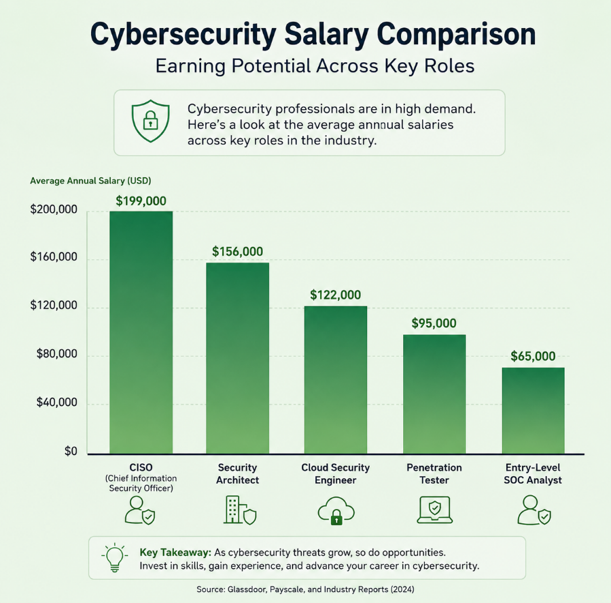
However, if you wish to keep things technical, don’t be disappointed – the paychecks will still be quite generous!
Security Architects: These top-level professionals create the corporate architecture and earn salaries in the range of $130,000 to $210,000.
Cloud & Application Security Engineers: One of our most rapidly growing fields at the moment. As such, these engineers provide direct protection to cloud deployments and application development pipelines, securing offers anywhere from $110,000 to $230,000.
Penetration Testers: Experienced ethical hackers, capable of actually exploiting their targets, are offered mid to senior salaries of around $115,000 to $205,000 and more.
SOC & IAM Analysts: Entry-level positions for SOC analysts start off in the range of $60,000 to $80,000. But if you choose to develop your specialisation in Identity and Access Management (IAM) early on, you’ll receive offers as high as $90,000.
The Certification Multiplier: Validating Your Premium
Let’s talk about credentials. Some practitioners dismiss certifications as mere pieces of paper, but recruiters view them as verified signals of expertise. In negotiations, they function as explicit salary multipliers. On average, certified professionals consistently out-earn their uncertified peers by 20% to 40%.

Take the CISSP (Certified Information Systems Security Professional). It remains the undisputed "gold standard" for management and senior engineering roles. Holding a CISSP provides an average 22% salary boost, pushing professionals into a reliable $130,000 to $170,000+ bracket.
If you want the highest immediate bump, look to the cloud. Credentials like the CCSP or AWS Certified Security deliver massive 25% compensation premiums, with specialised cloud security architects pushing past the $200,000 mark. On the offensive side, practical, hands-on certifications like the OSCP carry immense weight because they prove you can actually hack, bypassing the predictable multiple-choice format. Even foundational certs like CompTIA Security+ yield an 11% premium and open doors to strict, government-adjacent environments.
Mastering the Negotiation: How to Pull the Non-Base Levers
Here’s where most engineers trip up: they treat negotiation like a confrontation. It isn't. It’s a collaborative partnership. You are helping a hiring manager solve a critical business vulnerability.
Rule number one for corporate interaction? Don’t anchor too soon! Don’t disclose any information regarding your pay history and your salary expectations during your first screening phone interview. Absolutely acceptable is an answer such as: "I want to fully comprehend what my responsibilities will be, as well as the entire compensation package I would receive, before talking about salaries."
Should you have to quote any numbers, don’t talk about how much money you need to pay off your student loan or about your mortgage. You can be sure that the HR representatives from any company aren’t interested in your monthly rental expense. Provide a solid range of $10,000.
For specialised engineers, advanced practitioners, and cleared contractors, we highly recommend deploying the "20% rule." When you receive an initial written offer, counter with a highly structured, professional proposal for a 20% increase based on the specific scarcity of your skill set.
But what happens if the recruiter tells you they’ve hit a hard ceiling on the base salary band? This happens frequently at structured enterprises. Don't panic. Instead, pivot instantly to non-base financial levers:
Sign-On Bonuses: You can leverage sign-on bonuses to make up for all that equity or coming bonuses that you have left behind by switching employers.
Equity/RSU Offers: It is common knowledge that corporate restricted stock units may come from an entirely different budget than your base salary, providing hiring managers with additional room.
Budget for Professional Training: Training programs such as those of SANS/GIAC are quite expensive, costing thousands of dollars. You must include professional development budgeting in your offer package as this can be approved by recruiters very easily since it lies outside the headcount budget.
Geography and Clearances: The Hidden Premiums
Where you sit still matters, even in a cloud-first world. The San Jose-Sunnyvale-Santa Clara metropolitan hub leads global compensation with an average salary of $175,520. High-density states like Washington ($150,592) and New York ($133,100) also offer massive premiums, driven heavily by local tech concentration and intense financial compliance needs.
While remote roles are highly sought after, be prepared for geo-banded compensation. Many enterprise employers now pay 10% to 25% less if you live outside a major metropolitan tech hub.
Want an immediate, structural advantage? Get cleared. Professionals holding active government security clearances consistently command 10% to 20% premiums over uncleared counterparts. In a tight market, that clearance is an absolute golden ticket.
Securing Your True Value
Negotiating is not an act of being greedy. It simply involves ensuring that your pay is in line with the huge risk that you take for the company each and every day. With a proper understanding of market conditions and appreciation of your qualifications, you will be able to make yourself very valuable through negotiation of the complete package and not just salary.
Interested in taking the next step in your career? Learn how AmeriSOURCE can help you do that.
KEY TAKEAWAYS
Tie Your Bids to the Talent Shortage: With a global talent shortage of 4.8 million positions, you’ve got serious negotiating power if you’re a qualified cybersecurity candidate.
Apply Your Certification Multipliers: Certifications such as the CISSP and specific cloud certifications give you proven multipliers between 22% and 25% on top of salary.
Look Past Basic Salary Range: If basic salary ranges are fixed, negotiate for signing bonuses, RSUs, and professional development budgets for your SANS and GIAC courses.
Consider Geographic & Clearance Premiums: Add 10% to 25% for geography (geo-banding) and 10% to 20% for an active security clearance.



Comments