

Navigating Career Transitions: A Guide for Job Seekers
- Minakshi DEBNATH

- Apr 29
- 5 min read
MINAKSHI DEBNATH | DATE: APRIL 8, 2026

It doesn't announce itself. One day you just know this path isn't quite yours anymore. The instinct is to walk away clean. But the professionals navigating this well aren't erasing what they've built they're redirecting it. The question isn't "how do I escape?" It's "how do I take what I know somewhere new?" That shift in thinking changes everything.
Still, knowing the right question doesn't make the leap any less scary. According to Sedona Staffing’s guide on changing careers in 2026, successful transitions today are less about abandonment and more about applying your established value in new, higher-alignment contexts.
The New Math of the 2026 Market
To navigate a transition, you have to understand the logic of the people hiring you. The job market entered 2026 in a state of "cautious stabilization." It’s a market defined by extreme selectivity. Companies aren't betting on potential the way they used to. They want proof specific skills that deliver results from day one.
The data tells a sobering story. As noted in the PARWCC 2026 Career Coach’s Guide, the average hiring timeline now stretches between 55 and 71 days. That requires some serious financial and psychological stamina.
What’s more, there’s a digital gatekeeper you have to charm. While 81% of applicants use AI tools to find jobs, PARWCC reports that 63% are screened out by automated systems before a human ever sees their resume. If your digital branding isn't optimized for algorithmic compatibility, you are effectively invisible.
Overcoming the "Imposter" Inside
Even the most seasoned IT consultant faces a psychological wall during a transition. Imposter syndrome is real roughly 62% of knowledge workers globally struggle with it, according to Asana’s 2026 report on workplace cognitive patterns. When you’re moving into a new domain, that voice telling you you’re a "fraud" gets much louder.
Most of us know the feeling you hit a milestone and immediately wonder if you really earned it That little voice that whispers "they'll find out eventually" more people hear it than would ever admit it. And left unchecked, it has a way of slowing you down right when you should be accelerating.
When that voice gets loud, try this: Stop. Breathe. Notice. Reflect. Respond. SBNRR isn't complicated it just creates enough space between the doubt and the reaction to remind yourself that what you've built is real.
It sounds simple because it is. Originally highlighted by Purdue Global for adult learners navigating self-doubt, it works because it creates just enough space between the feeling and the reaction enough to remind yourself that what you've built is real, and so is your ability to keep building.
"Separate observable truths like positive project feedback from the internal narratives that interpret those truths as errors in judgment by others." Cedar Africa Group.
The Discovery Framework: Audit Before You Leap
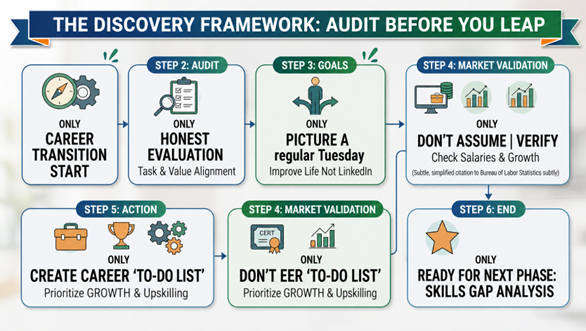
You wouldn’t migrate an ERP system without a full audit, right? Your career transition deserves the same rigor. Coursera’s 2026 step-by-step guide suggests a five-step assessment to find your "North Star."
The Career Audit Start with honesty. What parts of your current role actually align with who you are and what's quietly draining you? More often than not, it's not the work itself. It's the ceiling above you or the ground shifting beneath you.
Goal Clarification Forget the title for a moment. Picture a regular Tuesday. Are you leading a team or doing deep, focused work on your own? The role you're chasing should improve your actual life not just your LinkedIn headline.
Market Validation Don't assume verify. The U.S. Bureau of Labor Statistics exists for a reason. Check the salaries, check the growth projections. Most smart transitions in 2026 aren't reinventions; they're redirections of value you already have.
Closing the Gap: Skills and Certifications
Once you know where you’re going, you need to identify the "critical gaps." As Litmos explains in their skills gap analysis framework, a gap is critical if its presence leads to an unsatisfactory outcome in a core task of the target role.
For technical pivots, the bootcamp ecosystem has matured significantly. According to Course Report’s 2026 analysis, graduates see an average salary lift of $21,000.
App Academy: Focuses on software engineering with a 16-week immersive deferred tuition model.
Springboard: Offers 6-9 month programs with 1-on-1 mentorship and a job guarantee.
Nucamp: The most affordable option for web development with flexible evening sessions.
If you’re moving into management, Coursera notes that PMP or CAPM certifications are essential for demonstrating that your move into leadership is a purposeful, educated decision.
Translating Your Story for the Machines (and Humans)
Your 2026 resume has two bosses: the algorithm and the hiring manager. This is where "translation" becomes your most powerful tool.
According to the U.S. Department of Education’s Career Transition Hub, you must strip away industry-specific jargon. Words matter more than most people realize especially to an algorithm.
If you're making a sector shift, translate your language. "Policy analysis" doesn't register in a tech filter but "strategic planning" does. Same skill, different framing.
And be specific about impact. Don't say you "managed data" say you reduced escalations by 15%. Numbers cut through noise. The STAR method keeps it simple: Situation, Task, Action, Result.
Bypassing the Gatekeepers
In a market where 63% are rejected by AI, a personal referral is gold. Networking isn't just a "nice to have"it’s the only way to access the hidden job market.
Columbia University’s Career Education center calls it the "Informational Interview" and the name undersells it.It's not a pitch. It's a conversation. A simple email, a genuine ask, fifteen minutes of someone's time. Done right, it opens doors that no job board ever could.
Where the Growth Is
If you're wondering where to point your compass, the 2026 outlook is clear. According to Abilene Christian University, AI-related careers are projected to grow by 16%, while healthcare roles specifically Registered Nurses see a median salary of $93,600 with high demand.
Rank | Fastest Growing Role | Sector | Key Driver |
1 | AI Engineer | Technology | $101,752 median salary; building human-mimic models |
2 | Registered Nurse | Healthcare | $93,600 median salary; critical clinical need |
3 | Cybersecurity Analyst | Security | Defending networks from evolving digital threats |
The Long Game
This isn't a sprint and the professionals who thrive in 2026 know that.Seventy-one days is the average. That's not dead time that's runway.
Use it to sharpen your story, close the gaps, and treat every conversation as feedback. You're not waiting. You're iterating.
Your history isn't something to apologize for it's your foundation. You're not starting over. You're building on everything you've already done.
When you're ready to take that next step, AmeriSOURCE is here to help you move forward with purpose.
Key Takeaways
Redirect, don't restart: Your existing expertise is more valuable than you think the move is finding the right context for it, not abandoning it.
Speak the algorithm's language: A strong resume isn't just well-written it's built to be found. Translate your experience into language that works for the algorithm screening you out and the human deciding to bring you in.
Know your gaps, then close them: A honest skills audit tells you exactly where to focus whether that's a certification, a bootcamp, or something in between.
Protect your mindset: Long hiring cycles are the norm now. Techniques like SBNRR and success journaling aren't soft extras they're part of the strategy.
Get into rooms algorithms can't reach: Informational interviews open doors that job boards don't. The hidden market is real, and relationships are still the fastest way in.


Comments