

Unity in Purpose, Harmony inPractice.
- Probal DasGuota
- 6 days ago
- 8 min read
Updated: 5 days ago
Probal DasGupta, Ph.D. February 7, 2026

Strong teams are capable of achieving ambitious objectives while delivering meaningful financial benefits to an organization. Building effective teams is essential in any workplace, as high-performing groups can drive success, reach major milestones, and significantly reduce costs. Without strong leadership, however, teams can lose focus, allowing internal conflict to take priority over the real issues the organization must solve. “Effective teams are not accidental; they are created through deliberate effort and thoughtful design. When straightforward elements are brought together with sincerity, thoughtfulness, and empathy, success becomes highly likely.”

Leaders play a critical role in supporting each team member while uniting the group around the organization’s objectives. The effort should start with a well-defined and intentional strategy. Take the time to understand your team members individually, including how each person approaches thinking and problem-solving. Establish a common, well-defined approach to addressing challenges to encourage collaboration that is respectful, driven, and results-oriented. Most importantly, clearly define the team’s purpose so everyone understands it and feels inspired to work toward it.
Prioritize the people on your team before concentrating on the objectives they are meant to achieve.
To build a strong and effective team, leaders should prioritize the individuals within it before concentrating on collective objectives. Recognizing and valuing different thinking styles is essential, as successful teamwork depends on bringing diverse perspectives together to complete shared responsibilities.
"When individuals enter fresh settings and tackle novel obstacles collectively,
they frequently gain greater insight into one another's strengths and
capabilities." A team leader’s responsibility is to help members fully apply their “problem-solving strengths” to their work. This involves clearly defining the team’s purpose, fostering healthy and cooperative relationships, and guiding the group toward a common, well-understood approach to addressing challenges. When forming a team, intentionally account for each individual’s “preferred way of thinking”. Effective team leadership depends on understanding how each individual prefers to think and work - differences that are as varied as people’s experiences, expertise, and personal interests. Every team member approaches problem-solving in a unique way. Leaders who recognize and adapt to these differences are better positioned to guide their teams from analysis to decisive action. Sarah Thurber’s introduction to team-building came from an unexpected source: a blind date. When she learned that her date worked professionally as a team-building specialist, she asked how he typically helped teamscome together. He explained that his background as a camp counselor, educator, and outdoor leadership instructor often led him to challenge teams with physical activities in outdoor settings. This sparked a deeper question: “Are exercises like ropes courses and trust
activities what truly strengthen teams, or is the real transformation driven
by tackling meaningful challenges together?” He went on to describe a more refined and intentional approach he had developed over time. Through both practice and academic research on team motivation, he found that while physical challenges help establish trust, collaborative work on significant business problems creates stronger alignment and shared understanding. Teams that confront demanding, real-world challenges together tend to form deeper connections and work
more cohesively. As he explained further, his goal became combining these two benefits into a single approach. He designed immersive group experiences that require teams to actively collaborate while solving authentic business problems. These hands-on challenges consistently produce strong results. Thurber was captivated by this method and eager to explore it further. That curiosity ultimately led her to co-author a book on team leadership with her former blind date; now her husband, Blair Miller. Looking back, he
jokingly refers to their first meeting as “the interview.”
The FourSight problem-solving model is built around four distinct phases: clarification, idea generation, development, and execution.
This approach recognizes that effective problem-solving relies on multiple thinking styles and progresses through clear stages of action. Central to the model is the “FourSight Thinking Profile”, which helps individuals understand their natural tendencies when approaching challenges.
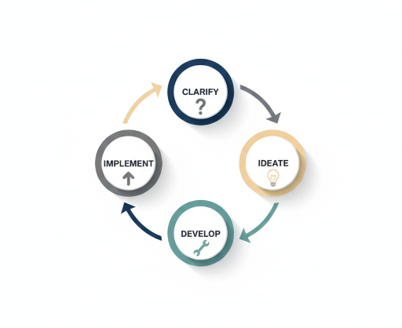
“Currently, my strategy for developing teams focuses on guiding them through practical problems collaboratively. Every so often, I find myself missing the ropes courses and trust exercises.” He paused with a hint of nostalgia, then smiled knowingly. “Of course,” he added, “my insurance costs dropped dramatically.” (Blair Miller) The FourSight framework provides teams with a clear structure for aligning around a common strategy. Its four stages serve as the foundation of the process: Clarify: Teams must first gain a shared understanding of the issue at hand. This involves asking focused questions, gathering relevant information, and organizing insights so the problem is clearly defined.
Ideate: During this phase, teams generate ideas freely and creatively, welcoming possibilities that stretch well beyond conventional thinking.
Develop: Here, teams refine their strongest ideas into practical, workable solutions that can realistically be implemented. Implement: This final stage moves plans into action, as teams test, present, and execute their solutions to achieve results. When teams work together to address challenges, differences in thinking styles can sometimes interfere with reaching agreement. 1. Clarifiers may linger too long on defining the problem, which can
slow progress and result in overanalysis.
2. Idea generators can become absorbed in bold concepts, overlooking important practical details, leaving their ideas disconnected from real-world constraints.
3. Developers may focus so heavily on refining details that they lose momentum while striving for an ideal solution.
4. Implementers often prefer to act quickly and may move forward before plans are fully formed, increasing the likelihood of errors.
This internal struggle can result in confusion rather than progress, as frustration builds and cooperation breaks down. Teams may slip into conflict, forming subgroups that undermine unity and reduce overall effectiveness. Overcoming this kind of communication breakdown is not instantaneous; it develops gradually as each team finds its own balance. Strong collaboration depends on mutual trust among team members, as well as confidence in the team’s leadership.
“At times, those we perceive as challenging may actually be the ones best equipped to contribute meaningful solutions.”
Building trust among individuals who start out as near strangers is never simple. Differences in thinking styles often become obstacles to collaboration, and people may misread alternative approaches as resistance rather than cooperation.
Team members who think in different ways can sometimes struggle to trust one another. When individuals hold unfavorable assumptions about thinking styles or preferences that differ from their own, they may begin to mistrust colleagues who approach work differently. This can lead to doubt about others’ problem-solving methods or confusion over why teammates choose alternative paths. Pay close attention to these tendencies:
Clarifiers typically feel most comfortable collaborating with other clarifiers or with developers.
Developers often prefer working alongside fellow developers or clarifiers.
Implementers tend to favor teaming up with other implementers.
Idea creators are generally open to working with anyone, although some team members may hesitate to collaborate with them. As the team grows and evolves, guide members to recognize these differences as valuable assets rather than obstacles. Encourage them to rely on one another’s strengths and use diverse thinking styles to enhance collaboration and overall effectiveness. Good teams need trust. A team reaches its objectives more effectively when it includes members who think in different ways. While cognitive diversity brings clear advantages, it can also introduce challenges. Some individuals struggle to collaborate with colleagues whose thinking patterns feel unfamiliar or unconventional. As the team leader, your role is to actively guide the group toward cohesion, confidence, and mutual trust. Keep the following
practices in mind:

1. Acknowledge strong performance wherever it occurs.
Give each team member goals that are demanding yet achievable.
Help individuals organize and balance their personal workloads.
Allow people to contribute in ways that highlight their unique abilities.
Make sure essential information is shared openly across the team.
Deliberately strengthen connections among team members.
Support the personal and professional development of each individual.
Model openness by showing your own vulnerability.
Notice contributions and consistently express appreciation for every team member.
Working together on meaningful challenges brings people closer. Through this process, psychological safety can develop, which is a foundational requirement for trust. When individuals feel secure interacting with one another, trust naturally grows. Google’s research initiative, Project Aristotle, found psychological safety to be the single most critical factor in creating a high-performing team. “Trust is essential to a strong team environment. Leaders can build trust rapidly, but that same trust can disappear just as fast if it is mishandled.” Because leaders influence up to 67% of their team’s “climate,” their position gives them significant power over how team members relate to one another. Leaders are responsible for fostering a “climate of productivity,” though it is important to distinguish climate from culture. Team climate represents a “snapshot of the team experience at any given time,” and it can be positively shaped by an engaged leader. Culture, by contrast, is deeply rooted in the organization and is far more difficult to change. Simply being part of a team can strengthen trust among individuals with different perspectives, as people are naturally social. At a fundamental level, belonging to a group contributes to happiness. Happier individuals tend to be more productive, more efficient, and more willing to trust others. Team development goes through multiple, diverse phases. Effective team growth unfolds through the following stages: “Forming”: Often described as the initial adjustment or “honeymoon” period, this stage occurs when individuals first come together as a team. Members may feel uncertain or cautious and typically rely on the leader for direction, structure, and reassurance. “Storming”: During this challenging phase, disagreements and competition may surface. Team members can struggle for influence or status, and emotional tensions or conflicts may disrupt progress if not managed carefully. “Norming”: At this point, the team begins to stabilize. Members move beyond personal differences, communicate more openly, and cooperate rather than compete. Conflicts are resolved through discussion, and those unwilling to adapt often exit the group. The
team starts functioning productively. “Performing”: This is the high-functioning stage where collaboration flows naturally. Team members are motivated, focused, and enthusiastic about working together to accomplish shared objectives. “Re-forming”: When team composition changes—through departures, new additions, or shifts in purpose the team naturally enters a re-forming phase. This period can be demanding, but experienced members often help restore momentum and clarity. “Closure”: The final stage occurs when the team completes its mission. Members conclude their work, reflect on achievements, and acknowledge the collective success of their efforts. Harness two essential problem-solving techniques: Reframe obstacles as inquiries and begin with positive recognition. Organizations have numerous methods available for addressing challenges. A particularly powerful strategy involves converting problems into question format instead of declarative statements. For example, rather than saying, "The workload is overwhelming me," consider asking, "Which approaches might enable me to manage growing work demands more effectively?"
"When facing personnel issues...build a group equipped to tackle any challenge."
Starting with acknowledgment before delivering criticism represents another impactful technique. This approach fosters trust and promotes sharper reasoning. Instead of immediately identifying weaknesses in a fresh proposal, first recognize what works well about it, then carefully express your reservations. Remain open to the opportunities the concept might create.
“Out of many, one” is an ideal motto for building strong teams.
The phrase E Pluribus Unum, meaning “out of many, one,” is printed on U.S. currency and reflects the core idea behind every effective team: distinct individuals coming together around a shared goal. Leaders who have a clear sense of who they are and how they personally approach problem-solving are best positioned to bring this idea to life. Equally important, leaders must deeply understand each team member in order to help individuals unite as a whole. A leader who masters three critical areas of insight; “know yourself,” “know your team,” and “know your challenge” -is prepared to guide a truly cohesive team.
"Bring people together through a clear mission...and equip them with a shared methodology for addressing complex problems."
Team leaders take on an added responsibility when part of the group works remotely. They must intentionally include individuals who work independently and help them feel fully connected to the team. At the same time, leaders continue to face familiar modern challenges, such as employee turnover and the influence of broader social issues. Even with these constraints, thoughtful leaders can still guide purpose-driven teams toward meaningful outcomes. By reinforcing a shared sense of purpose, you can help team members stay resilient and draw motivation from one another.


Comments