

The Evolution of Recruiting in the Digital Age: Leveraging AI and Automation
- Minakshi DEBNATH

- 3 hours ago
- 8 min read
MINAKSHI DEBNATH | DATE: APRIL 6, 2026 Nobody planned to reinvent hiring. The old system just collapsed under its own weight.
What replaced it looks almost nothing like what came before. The slow, local, paper-heavy process is gone. In its place is a machine that doesn't sleep, doesn't stop at borders, and runs on data. Cloud computing, natural language processing, and generative AI didn't make hiring more efficient they rewired it entirely.
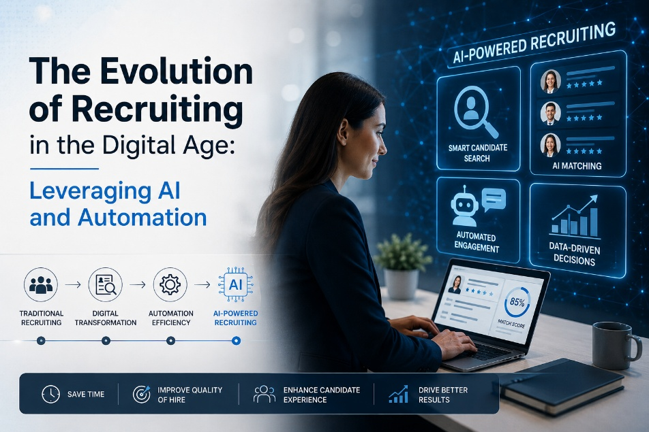
The last time this industry shifted at this scale was after World War II, when the first recruitment agencies emerged to meet a workforce in transition. That took decades to play out. This time, it's happening in real time and it's not waiting for anyone to catch up.
According to the Correct Context 2025 AI in HR and Recruitment Guide, AI adoption in talent acquisition jumped from 26% in 2024 to 43% in early 2025 less than a year. That's not a trend. That's a breaking point. So what actually triggered the surge? Because manual screening is completely broken. A thousand applications for one job. That's not a hypothetical that's a Monday morning for most engineering teams right now. And somewhere in that pile is the right person. But no recruiter, no matter how experienced or how fast, can give a thousand resumes the attention they deserve. The math simply doesn't work. Human capacity has a ceiling, and modern application volumes blew past it a long time ago.
The Historical Lineage: From Filing Cabinets to Keywords
To understand why modern recruitment technology has entered a cognitive revolution, we have to look back at the historical bottlenecks that got us here. The trajectory of recruitment tech is not a linear progression of efficiency, but a series of distinct paradigm shifts.
The Manual and Analog Foundations (1939–1990)
Modern recruitment actually owes its structural origins to the severe labor shortages of World War War II, when massive conscription forced a systemic workforce gap. As detailed in Connect2Kent’s historical industry analysis, this era established agencies as vital economic intermediaries to bring women into industrial sectors. For decades following, the standard practice relied entirely on physical proximity: newspaper classifieds, hand-delivered paper resumes, and massive steel filing cabinets. Efficiency was incredibly low; recruiters spent roughly 70% of their time on pure administrative tasks, pushing the average time-to-hire out to 43 days.
The Digitalization of Data and the Keyword Crunch (1990–2007)
Then came the internet. The launch of Monster.com in 1994 removed geographic boundaries, paving the way for the first generation of Applicant Tracking Systems (ATS). But this "Keyword Era" brought a new frustration: exact-match logic. If a recruiter searched for a "Java developer," the system would completely ignore a candidate who wrote "Java engineer." These rigid, early databases accidentally filtered out up to 75% of qualified candidates simply due to minor vocabulary differences.
The Integration and Social Recruitment Phase (2008–2020)
The 2010s didn't just bring new tools they brought a different way of thinking about where talent could come from.
Cloud computing removed the geographic ceiling. LinkedIn removed the waiting. Suddenly, a recruiter in Chicago could find a specialist in Singapore before their coffee got cold no job posting, no middleman. The hunt became proactive, and the industry never looked back. Hiring stopped being a waiting game and started feeling like a strategy.
Mobile applications made the process faster and more accessible. Candidate Relationship Management tools gave teams a way to actually track and nurture talent pipelines instead of losing great people in overflowing inboxes. On the surface, it looked like a revolution.
But pull back the curtain and the foundation hadn't moved an inch. Every single one of these platforms still ran on rules. If the condition was met, do this. If not, do nothing. There was no intuition, no context, no ability to read between the lines. The tools got shinier and faster but they were still just following instructions. The thinking? That part was still entirely on the human.
The Cognitive Shift: Reading Between the Lines
Today, we have moved from basic pattern matching to true contextual intelligence. Modern enterprise systems leverage AI in talent acquisition to fundamentally close the gap between what a professional writes and what they can actually achieve.

Through advanced Natural Language Processing (NLP), algorithms finally understand that "led technical staff" and "managed engineering teams" mean the exact same thing. The difference between the old way and the new way comes down to one thing: understanding. Early systems counted words. Modern deep learning models actually read them and more importantly, they read around them. How recently did you use that skill? How often? How deeply? Those are the questions a good recruiter instinctively asks in an interview. Now machines are asking them before the conversation even starts.
And the speed at which this happens is almost difficult to wrap your head around. A human recruiter, even a sharp one, gets through a resume in about 23 seconds. That's not a criticism it's just biology. Attention has limits. But an AI system doesn't skim. It doesn't lose focus halfway down the page or get thrown off by an unconventional format. It processes the whole thing, with semantic nuance, in milliseconds. Not faster reading a fundamentally different kind of reading altogether.
Predicting Success Before Day One
We are also moving away from reactive hiring toward predictive analytics. By assessing historical performance data of top internal performers, talent teams deploy advanced classification and time-series models to forecast long-term success.
According to data published in the X0PA AI 2025 Predictive Analytics Guide, organizations utilizing predictive talent models experience a 23% reduction in employee turnover and a 31% boost in overall quality-of-hire.
Furthermore, shifting to AI-driven, skills-based hiring improves performance accuracy by 22%, evaluating objective capability rather than a candidate's previous corporate titles.
The Generative AI Arms Race: Navigating the "AI Standoff"
Generative AI (GAI) has completely supercharged the administrative side of recruiting. Tools can now reduce the time it takes to draft hyper-personalized job descriptions and candidate outreach messages by up to 70%. When internal teams including our partners across QBA, AQcomply, IronQlad, and IbsynScientific leverage tailored, data-driven messaging, candidate response rates scale by 40%.
Efficiency always comes with unintended consequences. This one is particularly fascinating.
The same AI employers use to screen candidates is the same AI candidates use to beat the screening. Both sides leveled up simultaneously, and what followed was an arms race nobody declared but everyone is fighting.
It even has a name: the AI Doom Loop. Recruiters now open their inboxes to thousands of resumes that are polished, identical, and impossible to distinguish. So impossible that 76% of hiring managers say they genuinely can't tell if what they're reading is real anymore.
Some candidates go further embedding hidden prompts in white text to manipulate parsing algorithms directly. Employers counter with fraud detection and behavioral analysis tools. One step forward pulls another back, yet right between them, the person slowly fades. Amid shifting reactions, staying real feels like losing ground.
Moving Beyond Text: VR and Real-World Assessment
These days, old-style paper CVs feel less convincing. So smart companies explore deeper options - like VR or AR to test skills closely. Instead of just reading words on a page, they watch how people act inside lifelike digital situations. Trust builds better that way. Not through claims. Through doing. Instead of guessing how an operator or engineer will handle a high-stress situation, companies use VR to build realistic job previews. For instance, global giants like Medtronic utilize VR to train and evaluate healthcare professionals on intricate medical equipment under simulated, error-aware conditions. Drivers at UPS face realistic simulations that challenge their ability to spot dangers on routes. Because applicants live through a typical shift prior to accepting roles, companies sharply reduce poor initial fits.
The Ethical and Regulatory Imperative
There's a problem sitting at the centre of AI recruitment that doesn't get enough airtime: the Historical Data Trap.
Machine learning models don't invent their own preferences they learn from decisions humans already made. Every bias that ever quietly shaped a hiring outcome gets fed into the model, and the model replicates it at scale.
The uncomfortable part? Removing obvious identifiers doesn't fix it. Strip out gender, remove race the bias doesn't disappear. It just travels through proxy signals instead. Zip codes. School names. Career gaps. The pattern was baked into the outcomes the algorithm was trained on, and it will find it regardless.
As a result, compliance has shifted from a back-burner HR issue to a strict procurement barrier.
Conduct Annual Independent Bias Audits:
Required by NYC Local Law 144.
Automated employment decision tools must undergo independent data testing to check for disparate impact, with results published publicly.
Establish High-Risk Data Governance:
Mandated by the EU AI Act.
Recruitment AI platforms deployed in the EU market must maintain continuous logging, strict data quality controls, and certified risk mitigations.
Enforce Strict Third-Party Liability Oversight:
Driven by EEOC Title VII Guidance.
Enterprise buyers must monitor vendor software constantly, as employers remain directly liable for systemic bias generated by automated hiring systems.
The New Recruiter: Less Admin, More Strategy
So, will AI replace the recruiter? Not even close. If anything, it is making the human element more critical than ever.
As automated platforms take over data parsing and interview scheduling, human professionals are stepping into the roles of Strategic Talent Advisors and Career Coaches. With routine tasks automated, the demand for human emotional intelligence has skyrocketed. Recruiters must focus exactly where algorithms fail: reading the intangible personality traits that signal cultural alignment, calming anxious candidates, and navigating nuanced executive compensation negotiations.
The ultimate objective is a "human-led, AI-enabled" model. By leveraging technology to manage high-volume complexity, talent teams can return to what recruiting has always been at its core: a deeply human interaction rooted in potential, relationship building, and mutual trust.
Explore how AmeriSOURCE and our broader corporate network, including AJA Labs and bodHOST, can help your organization seamlessly integrate advanced AI and digital transformation frameworks into your human capital strategy.
KEY TAKEAWAYS
The AI Integration Surge
AI in recruiting didn't gradually ease its way in it arrived at scale. Adoption jumped to 43% globally in early 2025, and the reason is straightforward: the volume of applicants had simply outgrown human capacity. What was once a competitive advantage for well-resourced companies became something far more basic a necessity just to keep up.
The AI Standoff
Here's the uncomfortable irony. The same AI tools that employers are using to screen candidates are the tools candidates are using to game the process. Polished AI-generated resumes meeting AI-powered filters and somewhere in the middle, authenticity got lost. The response has to be immersive assessments and real human judgment, because a system evaluating a system tells you almost nothing about the actual person.
Predictive & Skills-Based Success
Job titles have always been a lazy proxy for capability. Predictive talent analytics finally give organizations a way to move past them. When hiring is built around actual, measurable skills rather than what someone's business card used to say, the results speak for themselves employee turnover drops by 23%. That's not a minor efficiency gain. That's a structural improvement in how teams are built.
Strict Compliance Frontiers
The regulatory environment is catching up fast. The EU AI Act and NYC Local Law 144 are early signals of a much broader shift one where AI tools used in hiring must be transparent, explainable, and subject to human oversight. This isn't optional fine print. It's the new baseline, and organizations that treat it as an afterthought will feel it.


Comments