

The Great Realignment Navigating the New Era of Remote Work and AI Orchestration
- Shilpi Mondal

- 1 day ago
- 5 min read
SHILPI MONDAL| DATE: APRIL 10, 2026

It’s time we stop talking about the "return to the office" as if it’s a pending event. In my conversations with CIOs this year, a common theme has emerged: we aren't waiting for a new normal anymore we are living in it. The experimental phase of the early 2020s has matured into a fundamental structural realignment of global labor.
According to data compiled by Gable, the telework rate in the U.S. has stabilized between 17.9% and 23.8%, a baseline five times higher than what we saw pre-pandemic. For those of us in the technology sector, the shift is even more dramatic. WorkTime’s 2026 Remote Work report indicates that around 27% of offsite-capable employees are fully remote. We’ve moved past the “where” of work; the real challenge now is the “how” specifically, how we orchestrate a borderless, AI-augmented workforce without losing our organizational soul.
The Productivity Paradox and the Rise of "Coffee-Badging"
Remote work isn't just a perk anymore it's become a genuine productivity shift for a lot of people. And the numbers are starting to reflect that. Splashtop's 2025 Remote Work Trends shows that remote employees are either maintaining or actually improving their performance, which shouldn't be that surprising when you think about what's driving it. More control over your schedule, fewer interruptions, and the freedom to work in a way that actually fits your life tends to bring out better work. Then there's the commute factor and honestly, it's bigger than most leaders give it credit for. Getting that time back doesn't just reduce stress, it means people are starting their day with more energy and mental clarity, and that adds up over time.
But here's the thing: while 87% of employees feel productive, 85% of leaders still don't trust them. This "productivity paranoia," as highlighted in the WorkTime report, has gotten a little out of hand and the behaviors it's breeding are genuinely strange. Take "coffee-badging." Owl Labs' 2025 State of Hybrid Work found that 43% of hybrid employees are literally showing up just long enough to be seen coffee in hand, badge swiped then turning right back around to go home and do their actual work.
That tells you everything you need to know about where the disconnect is. As advisors, we have to push our clients past the optics and into what actually matters: results. Are deadlines being met? Is the quality there? Is the team moving forward? Those are your KPIs not who walked through the door. If you're still measuring presence over performance, you're solving the wrong problem.
The AI Architect: Flattening Hierarchies and "Process Pros"
By late 2026, the way most organizations are structured is going to look pretty different and AI is a big reason why. Gartner's future of work trends paints a clear picture: roles are shifting, workflows are being rebuilt from the ground up, and companies are actively rethinking what it means for humans and machines to work side by side on a daily basis. It's not a distant concept anymore it's already happening in a lot of places. And as AI starts absorbing the routine stuff the coordination emails, the status reports, the administrative back-and-forth that eats up half a manager's week something interesting is opening up. Managers are getting pulled toward the work that actually requires them: thinking strategically, spotting opportunities, and leading real transformation instead of just keeping the wheels turning.This shift isn’t just about reducing headcount it signals the rise of a new kind of professional: the “Process Pro.” Organizations that rethink and redesign entire workflows around AI, rather than using it as a simple productivity tool, are far more likely to outperform their revenue goals. At the same time, a new phenomenon is emerging in forward-looking companies: “digital doppelgangers.” Employees are beginning to train AI replicas of themselves to handle routine queries and sit in on lower-priority meetings. What once sounded like science fiction is quickly becoming part of everyday work in the human–machine era.
A Borderless Talent Market: The Rise of the "Meta City"

The unbundling of work from location has turned the hunt for talent into a global game. The World Economic Forum predicts that global digital jobs will hit 92 million by 2030. This borderless reality is changing our cities. Urbanist Richard Florida describes this as the "Rise of the Meta City," where hubs like New York or London become places for connection and consumption, while the actual work happens in satellite communities or across oceans.
This shift has a darker side: the commercial real estate crisis. Chicago Booth’s analysis suggests NYC office values could plummet up to 67% below 2019 levels by 2030. For firms like AmeriSOURCE, this means helping clients rethink their physical footprint shifting from "places of work" to "places of collaboration."
The Regulatory Horizon: Mental Health and the Right to Disconnect
Work and home life have never been more tangled, and governments are starting to take that seriously. In Brazil, updated NR-1 regulations now hold employers directly responsible for managing psychosocial risks think burnout, relentless workloads, and the kind of chronic stress that doesn't clock out as a core part of workplace safety. Europe, meanwhile, is cracking down on how algorithms influence HR decisions, with new AI regulations putting hiring and promotion tools under a much brighter spotlight; organizations will need to demonstrate compliance through rigorous audits. And for businesses that operate across borders, there's a little breathing room on the tax front too recent international updates include provisions like a 50% working-time threshold that can help companies sidestep the headache of unintentionally triggering permanent establishment obligations.
Modular Benefits: The Personalized Lifestyle Ecosystem
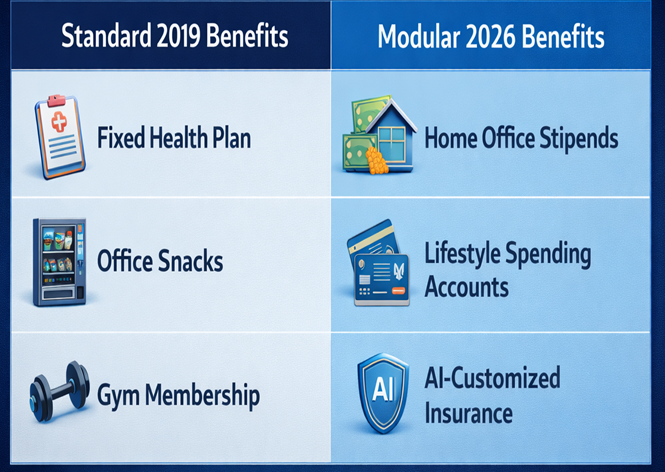
The standard benefits package is dead. In a remote-first world, employees want support that fits their specific life stage. Pierpoint International highlights a shift toward "modular flexibility," where AI platforms help employees choose between childcare subsidies, student debt relief, or mental health support.
Since employers save about $11,000 per year for every offsite worker, as noted by WorkTime, redirecting those savings into personalized benefits isn't just nice it's a retention strategy. Mental health is no longer a "perk"; it’s a requirement. In fact, Chanty’s 2026 research found that 70% of employees would trade office perks for guaranteed mental health days.
Strategic Synthesis: Building for 2030
The transition we are witnessing is not a temporary trend; it is a fundamental reimagining of value creation. To thrive in the coming decade, organizations must embrace:
Async-First Resilience: Prioritizing documentation over meetings to protect "deep focus" time.
AI Synergy: Going beyond automation to rethink how humans and AI agents actually work together not side by side, but as a genuine team.
Trust-Based Leadership: Letting go of "command-and-control" and instead leading through outcomes, accountability, and trust.
The companies that will pull ahead aren't necessarily the loudest or the largest they're the "Growth Collaborators," the ones quietly building cultures where trust runs deep and decisions don't have to travel up ten layers before anything gets done. Whether you're finding your footing in the shifting landscape of the "Meta City" or figuring out how to weave AI meaningfully into a workforce that spans the globe, the throughline is the same: people still have to come first, even when the world around them is moving fast. If that's the journey you're on, AmeriSOURCE alongside partners like IronQlad.ai and QBA is ready to help you build something that actually lasts.
KEY TAKEAWAYS
The Baseline is Set: Remote work has stabilized at 5x pre-pandemic levels, with the IT sector leading the charge at nearly 50% fully remote.
AI as an Architect: Middle management is being automated, shifting the focus to "Process Pros" who can orchestrate human-machine workflows.
Regulatory Shift: New mandates in the EU and Latin America are forcing companies to take legal responsibility for employee mental health and AI ethics.
The "Meta City": Urban centers are shifting from places of production to places of consumption, with office values projected to drop significantly by 2030.
Personalized Well-being: Retention in 2026 depends on modular benefits—specifically mental health support and lifestyle spending accounts.


Comments