

“The System Wouldn’t Allow That”: The Most Dangerous Sentence in Enterprise Risk
- Probal DasGupta
- Apr 9
- 4 min read
Entrepreneur. Storyteller. Systems Thinker. | Architect of Enterprises That Think | Founder & CEO.
January 23, 2026

After three decades in enterprise technology leadership, there’s one phrase that still makes me flinch every time I hear it in a boardroom: “The system wouldn’t allow that.”
It’s usually said with confidence. Sometimes with relief, like the speaker has just found the perfect alibi. And almost every time, it’s wrong. What’s really happening is this: we’ve quietly replaced human judgment with checkbox confidence. Automated approvals have become stand-ins for scrutiny. Configurations now masquerade as governance. Vigilance hasn’t disappeared because people stopped caring, it’s eroded because we started believing our systems were infallible. They aren’t.

When controls are treated like guarantees instead of guardrails, exceptions don’t just slip through, they accumulate quietly. Minor gaps compound. And when they finally surface, the failure is rarely small. That risk has never been higher than it is today.
Why This Risk Keeps Growing
Look at how your enterprise actually operates now. Cloud platforms. SaaS applications. Low-code tools. AI- driven workflows. Third-party integrations holding critical processes together. Decisions made by people scattered across the organization, using systems that were never designed to behave as a single whole. Each platform brings its own control model, identity framework, and exception paths. Leaders assume consistency. Reality delivers fragmentation.At the same time, business pressure is relentless. Speed matters. “Digital transformation” leaves little patience for careful control design. Controls get bolted on later, retrofitted onto processes that were never built to support them.The result is fragile.
Leaders assume controls are tighter than they are. Teams assume someone else is watching. And in the gap between assumption and reality, risk settles incomfortably.
Controls Work Great; Until They Don't
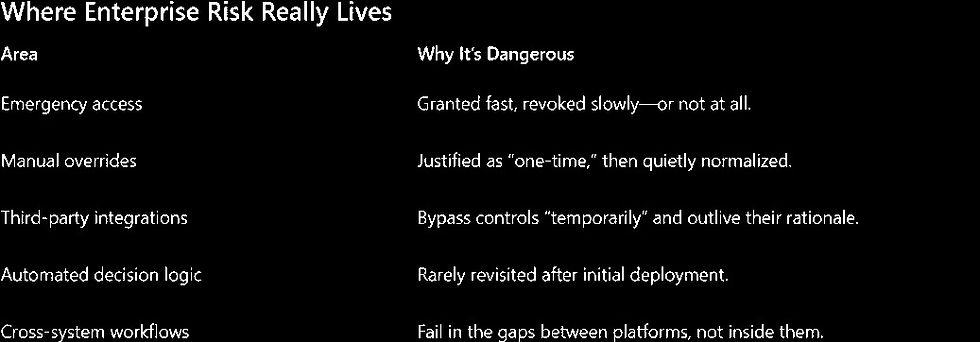
Enterprise systems handle standard workflows extremely well. That’s not where risk lives. Risk lives in the exceptions:
The urgent override approved at midnight
The manual reconciliation done “just this once”
The emergency access granted during a crisis and never revoked
I’ve traced multimillion-dollar losses back to a single privileged access grant that quietly stayed active. I’ve seen compliance failures triggered by “temporary” integrations that bypassed controls for eighteen months.
The system allowed it, because someone configured it that way, and no one went back to look. If your confidence is based on what the system usually does, you’re blind to where it actually fails.
Automation Creates Dangerous Blind Spots
Look, automation is essential. You can't run an enterprise on manual controls anymore, it's not realistic. But automation without clear accountability creates something worse than inefficiency: it creates false confidence. Here's what happens: once a workflow gets automated, people stop asking why decisions are being made. They just check that the workflow ran. Green lights equal success. Nobody questions the logic underneath anymore. I worked with an organization that automated their vendor onboarding process and cut their cycle time by 60%. Everyone celebrated. Then they had a third-party breach, and we discovered nobody had looked at the risk scoring thresholds in three years. The system was working exactly as designed. The assumptions behind the design were dangerously outdated.
Every automated control needs someone, an actual person with a name and responsibility - who understands how it works, what assumptions it's built on, and how it could fail. Not just a name on an org chart. Someone who genuinely knows.
Complexity Is Killing Your Assurance
Modern enterprise architectures are sprawling. You've got your ERP system, your CRM, and probably dozens of SaaS tools scattered across departments. Each one enforces its own controls. Very few enforce them holistically. You assume consistency. Reality gives you fragmentation.
In that environment, "the system wouldn't allow that" is almost meaningless. One system might block something while three others quietly permit it. Most risk programs miss this because they audit systems one at a time instead of looking at how outcomes actually flow end-to-end.
A small misconfiguration in one platform can cascade across your entire enterprise faster than you'd think possible.
Culture Matters More Than Any Control
Here's what gets left out of every risk management framework: culture. When you say "the system wouldn't allow that," you're not just making a statement. You're sending a signal. The signal is: questioning isn't necessary here. Scepticism is inconvenient. The controls have this handled.
Teams pick up on this instantly. They learn fast when challenge is welcome and when it's career-limiting. The best organizations I've worked with cultivate something I think of as constructive paranoia. Controls are respected but never blindly trusted. Leaders ask "how could this fail?" just as often as they ask "is this compliant?" They create environments where raising uncomfortable questions is rewarded, not punished.
Culture doesn't replace your controls. It determines whether people actually use them the way they're supposed to.
What You Can Do Right Now
If any of this resonates uncomfortably, that's actually good. Here's where you can start:
Focus on exceptions, not just standard processes: That's where the real risk hides. Shift your attention to override mechanisms, emergency processes, and those "temporary" workarounds that became permanent.
Put names on your critical automations: Every major automated control should have an executive who owns it, someone responsible for understanding its assumptions and keeping them current.
Test how things actually flow: Stop validating controls inside individual systems. Start testing how they work across your integrated workflows, because that's how your business actually operates.
Refresh your thresholds regularly: Business context changes faster than control configurations do. Review your risk thresholds at least once a year, or whenever you go through a major change.
Change the language: Replace "the system wouldn't allow that" with "show me how we know." It seems small. It's not. The words leaders use shape how everyone else thinks.

Vigilance Is a Choice

Systems are powerful tools. Controls are necessary. But neither one lets you off the hook.The most resilient organizations I've seen don't trust their systems blindly. They verify constantly. They challenge assumptions. They keep evolving. They treat controls like living things that need attention, not monuments you build once and forget about.
When technology enables this much speed and scale, staying vigilant isn't just good risk management, it's a competitive advantage. The real danger isn't that your system will fail. It's that you'll stop paying attention because you've convinced yourself failure is impossible. So next time someone says with complete confidence, "The system wouldn't allow that," do me a favour: pause. Take a breath. And ask one more question. That instinct to dig deeper, to verify rather than assume, it might be the most valuable control you have.


Comments