

When Your CFO's Voice Becomes a Weapon
- Probal DasGupta
- May 8
- 5 min read
Entrepreneur. Storyteller. Systems Thinker. | Architect of Enterprises That Think | Founder & CEO.
December 24, 2025

The scenario is no longer the plot of a spy thriller. It is a Monday morning reality for modern finance departments.
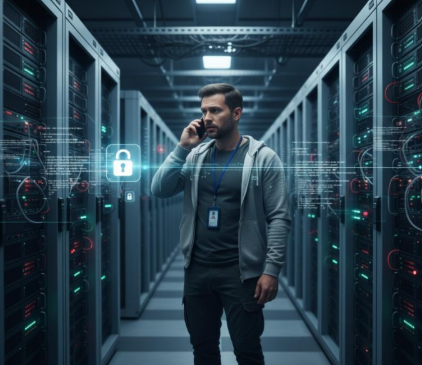
The call comes in. Your regional controller recognizes the voice immediately; it's the Group CFO, same cadence, same slight impatience when deals are moving fast. The request is logical: an urgent wire transfer to lock down a competitive acquisition before markets open. The controller bypasses standard protocol, certain they're executing a direct executive mandate.

They haven't been scammed. They've been engineered; by a high-fidelity voice clone generated from 30 seconds of audio scraped from last quarter's earnings call.
Business Email Compromise has evolved beyond typo squatted domains and urgent subject lines. The new attack vector isn't your inbox; it's biological trust, the instinct that tells us a familiar voice means a familiar person. For enterprises, this shift transforms routine fraud into a gateway for corporate espionage.
The $40 Billion Breakdown
Traditional BEC relied on suspension of disbelief. Attackers would monitor email chains for weeks, learning to mimic writing styles. Generative AI collapsed that timeline. According to Deloitte's 2024 analysis, GenAI-enabled fraud losses are projected to reach $40 billion in the U.S. alone by 2027, driven largely by voice cloning that requires only
seconds of public audio to generate real-time conversational models.
The financial impact tells only half the story. According to Gartner's 2025 research, 43% of organizations have already encountered at least one deepfake audio incident. But unlike gift card scams, these attacks increasingly target intellectual property rather than treasury accounts. A cloned CTO calling a DevOps lead doesn't ask for money; they request access to proprietary codebases, cloud environments, or M&A intelligence. The voice isn't the endgame; it's the entry point for long- term exfiltration.
Why Your Security Training Failed You
We spent a decade teaching employees to hover over links and verify sender addresses. We never taught them to doubt their own ears.
Voice conveys authority, urgency, and emotion; signals that bypass the logical checks applied to email. According to Microsoft's 2024 Digital Defense Report, modern
synthetic audio has reached the point where human ears cannot reliably distinguish authentic from AI-generated speech. When a voice clone sounds identical to a known
superior, the "obedience to authority" bias overrides security instincts. The employee isn't looking for red flags - they're solving a problem for leadership.
Gartner's 2024 forecast underscores the scale of erosion: by 2026, 30% of enterprises will no longer consider voice biometric authentication reliable in isolation. The technology we once considered foolproof is now a liability.
The Operational Dilemma Executives Can't Ignore
Here's the tension your CISO won't put in the board deck: Rigorous verification slows business down.

If your controller must confirm every verbal request out-of-band, how do you close quarter-end across three time zones while your CFO is managing investor calls? If your engineers challenge every urgent production fix request, what happens to incident response windows?
The answer isn't abandoning verification - it's tiered risk protocols:
For routine operations (under $10K, non-sensitive data): Single-channel verification acceptable, with periodic random audits to maintain alertness.
For material transactions (above threshold, IP access, M&A-related): Mandatory dual-channel confirmation using pre-established, encrypted communication paths. Not the callback number provided in the request - the number already in your corporate directory.
For crisis scenarios (active incidents, time-critical decisions): Pre-negotiated challenge-response phrases known only to specific role pairs, rotated quarterly and never documented digitally. Think military authentication protocols, not security theater.
According to IBM's 2024 Cost of a Data Breach Report, organizations extensively using security AI and automation contained breaches 98 days faster than those relying on manual processes alone. The trade-off isn't speed versus security - it's intelligent automation versus operational paralysis.
What Actually Works: Three Defensive Layers

Technology: Synthetic Audio Detection: Deploy specialized platforms that analyze incoming calls in real time, examining latency patterns and frequency distributions
invisible to human perception. Current-generation tools from providers like Pindrop, Attestiv, and Reality Defender can flag synthetic signatures, though false positive rates remain a consideration for high- volume environments.
Process: Out-of-Band Verification as Default: Any verbal request tied to financial authorization over your materiality threshold or sensitive data access requires confirmation through a separate, trusted channel. This isn't optional or discretionary - it's embedded in your financial controls and access management workflows the same way dual signatures once were for physical checks.
Culture: Authorized Skepticism: The weakest link isn't technology or process - it's the junior analyst who hesitates to verify a request because questioning leadership feels disrespectful. Real resilience requires psychological safety where verification isn't just permitted, it's expected. When your newest team member feels confident pausing a request from a C-level voice to confirm through proper channels, you've built the cultural firewall that matters.
The Decision Framework You Need Now
Assess your exposure:
Do executives regularly appear in public forums, earnings calls, or conferences where voice samples are accessible?
What's your current materiality threshold for requiring dual authorization on financial transactions?
How many high-value IP repositories currently rely on voice-authenticated access?
Evaluate current controls:
Can employees easily reach verified contacts through channels independent of inbound requests?
Do your financial controls explicitly address verbal authorization, or do they assume written documentation?
What's your mean time to detect unauthorized access in cloud environments?
Calculate the risk-friction trade-off:
What percentage of urgent requests actually require sub-30-minute turnaround?
What's the operational cost of a 5-minute verification delay versus a $2M fraudulent transfer?
How does your D&O insurance currently address social engineering claims?
If your answers suggest material exposure without corresponding controls, this moves from "monitor" to Q1 2026 priority.
Conclusion: Securing the Human Connection
Voice cloning weaponizes the biological familiarity that keeps business moving. As generative tools commoditize, the gap between trusted colleague and synthetic impersonator effectively vanishes. A laptop and publicly available audio are now sufficient to convincingly inhabit your CFO's persona.
The corrective isn't just technology - it's operational discipline. Advanced detection tools matter, but your most robust firewall remains the strength of internal processes and the willingness of employees to pause high-stakes requests even when it feels redundant.
According to the World Economic Forum's 2024 Global Risks Report, AI-generated misinformation now ranks as the most severe global risk over the next two years, surpassing economic instability and traditional cyber threats. When a leader's identity can be synthesized in seconds, security can no longer be a compliance checklist. It must be embedded in culture, where verification isn't awkward; it's how professionals operate.
The question isn't whether voice cloning will target your organization. It's whether your processes and culture are strong enough to stop it when it does.


Comments