

Federated Cybersecurity: Collaborating Without Sharing Data
- Minakshi DEBNATH

- Sep 3, 2025
- 3 min read
MINAKSHI DEBNATH | DATE: MAY 22,2025

Introduction: The New Frontier in Cyber Defense
In an era where cyber threats are becoming increasingly sophisticated and pervasive, traditional centralized cybersecurity approaches are proving insufficient. The need for collaborative defense mechanisms that respect data privacy has led to the emergence of federated cybersecurity—a paradigm that enables organizations to work together in identifying and mitigating cyber threats without the necessity of sharing sensitive data.
Understanding Federated Cybersecurity

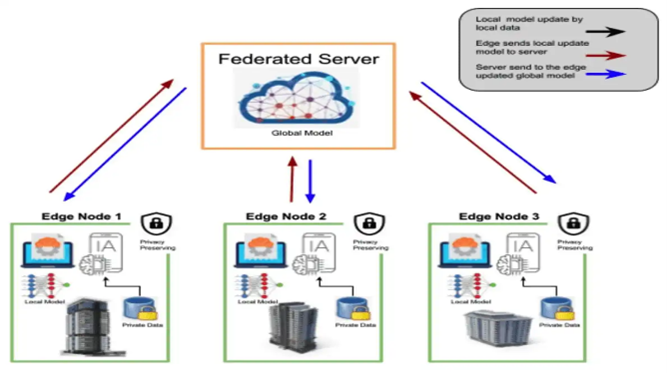
Federated cybersecurity is an extension of federated learning, a machine learning technique where multiple entities train a shared model collaboratively while keeping their data localized. In the context of cybersecurity, this approach allows organizations to collectively detect and respond to threats by sharing model updates or threat intelligence, rather than raw data. This method not only enhances privacy but also enables real-time threat detection across diverse environments.
Real-Time Attack Pattern Recognition
The dynamic nature of cyber threats necessitates real-time detection and response capabilities. Federated cybersecurity facilitates this by allowing organizations to collaboratively train models that can recognize attack patterns as they emerge. For instance, a study published in Scientific Reports demonstrated the use of hybrid quantum-enhanced federated learning for cyberattack detection, highlighting the potential of this approach in identifying diverse attack patterns in real-time .
Moreover, companies like Darktrace have emphasized the importance of real-time threat detection, which relies on continuous monitoring and AI-driven analysis to identify and respond to threats as they occur . By integrating federated learning with such real-time detection systems, organizations can enhance their ability to detect and mitigate threats promptly.
Applications Across Critical Sectors
Finance
The financial sector is a prime target for cybercriminals due to the sensitive nature of the data and the potential for financial gain. Federated cybersecurity allows financial institutions to collaborate on threat detection without exposing proprietary or customer data. By sharing model updates, banks and other financial entities can collectively improve their defenses against fraud, phishing, and other cyber threats.
Healthcare
Healthcare organizations handle vast amounts of personal and sensitive data, making them attractive targets for cyberattacks. Federated cybersecurity enables these institutions to collaborate on detecting and responding to threats while maintaining compliance with privacy regulations like HIPAA. The U.S. Department of Health and Human Services has recognized the importance of such collaborative approaches in bolstering healthcare cybersecurity.
Government
Government agencies often operate in silos, which can hinder effective cybersecurity. Federated approaches allow for inter-agency collaboration on threat detection and response without compromising sensitive information. Programs like the State and Local Cybersecurity Grant Program by FEMA support initiatives that promote such collaborative cybersecurity efforts .
Challenges in Implementation and Privacy Guarantees

While federated cybersecurity offers numerous benefits, it also presents several challenges
Data Heterogeneity: Different organizations may have varying data structures and quality, which can affect the performance of the shared models.
Communication Overhead: Frequent exchange of model updates can lead to increased network traffic and latency issues.
Security of Model Updates: Ensuring that the shared model updates are not tampered with or used to infer sensitive information is critical.
Scalability: As the number of participating entities increases, managing the federated learning process becomes more complex.
The National Institute of Standards and Technology (NIST) has discussed these challenges in the context of privacy-preserving federated learning, emphasizing the need for robust threat modeling and real-world deployment strategies .
Conclusion: A Collaborative Path Forward
Federated cybersecurity represents a promising shift towards collaborative defense mechanisms that respect data privacy. By enabling real-time threat detection and fostering cooperation across sectors, this approach can significantly enhance our collective cybersecurity posture. However, addressing the associated challenges requires concerted efforts in research, standardization, and the development of robust frameworks to ensure secure and effective implementation.
Citation/References
State and Local Cybersecurity Grant Program | FEMA.gov. (2024, September 23). https://www.fema.gov/grants/preparedness/state-local-cybersecurity-grant-program?
Fox, A. (2025, May 20). The government should invest now in healthcare cybersecurity, says HSCC. Healthcare IT News. https://www.healthcareitnews.com/news/government-should-invest-now-healthcare-cybersecurity-says-hscc?
Pattison-Gordon, J. (2024, August 9). Federal authorities work to boost Health-Care Cybersecurity. GovTech. https://www.govtech.com/health/federal-authorities-work-to-boost-health-care-cybersecurity?
Makris, I., Karampasi, A., Radoglou-Grammatikis, P., Episkopos, N., Iturbe, E., Rios, E., Piperigkos, N., Lalos, A., Xenakis, C., Lagkas, T., Argyriou, V., & Sarigiannidis, P. (2024). A comprehensive survey of Federated Intrusion Detection Systems: Techniques, challenges and solutions. Computer Science Review, 56, 100717. https://doi.org/10.1016/j.cosrev.2024.100717
GmbH, E. (n.d.). Federirano učenje u kibernetičkoj sigurnosti: Poboljšanje privatnosti i sigurnosti podataka - Eunetic. https://www.eunetic.com/en/kb/advanced-topics/federated-learning-cybersecurity-enhancing-data-privacy-security?autotrans=hr
Image Citations
Mark. (2024, May 28). Federated Learning: Collaborative AI Training without Sharing Raw Data. Zipfian Academy. https://www.zipfianacademy.com/federated-learning/
Isaksson, C. (2023, August 11). Federated Learning for Cyber Security: What you need to know in 2021. phData. https://www.phdata.io/blog/federated-learning-for-cyber-security/



Comments